Posts

Showing posts from January, 2012

The unit of work and energy was named after him: James Prescott Joule

Image
About James Joule James Prescott Joule   James Prescott Joule (1818–1889), Scotland.   James Prescott Joule was one of five children in the family of a well-to-do brewery owner. Since he was a sickly child with a spinal deformity, both he and his brother were educated at home until the age of 15 and later by private tutors.    The famous English chemist, John Dalton , taught them chemistry, physics, and the methods of scientific experimentation .    Later in life Joule acknowledged that John Dalton encouraged him to increase his knowledge of science and of original research.   When James’ father died, he and his brother ran the brewery, which prevented him from attending a university. However, this did not deter him from setting up a laboratory in his home and continuing his interest in science after his day at the brewery. He became proficient in mathematics and learned how to make accurate measurements in the ...

The comparison between adhesion and cohesion- osmotic pressure

Image
The comparison between Adhesion and cohesion       The force of attraction between molecules of the same substance is called Cohesion , as distinct from Adhesion or the force between molecules of different substances. Osomosis animation Comparison between water and mercury     The adhesion of water to glass is stronger than the cohesion of water. Hence, when water is spilled on a clean glass surface  it wets the glass and spreads out in a thin film. On the other hand, the cohesion of mercury is greater than its adhesion to glass. Therefore , when mercury is spilled on glass it forms small spherical droplets or larger flattened drops.     The difference between the adhesive and cohesive properties of water and mercury explains why meniscus of water curves upwards and that of mercury curves downwards when these liquids are poured into clean glass vessels ( as shown in the picture below).       T...

Graham's law of diffusion - Further illustration of surface tension

Image
Graham's law of diffusion The speed with which molecules move about inside a gas depends on their mass and temperature . Thus, at a given temperature the heavy molecules of carbon dioxide " CO2" move more slowly than the light molecules of hydrogen . This has an important bearing on the rate at which one gas will diffuse into, or mix with, another.     Tomas Graham found that, at constant temperature gases diffuse at rates which are inversely proportional to the square roots of their densities. This is known as Graham's law of diffusion. This video demonstrates this law Diffusion experiment      The difference in the rates of diffusion of two gases through a porous partition may be demonstrated by a simple experiment.- I'm sorry but you have to use your imagination :) -.  An unglazed earthenware pot is fitted with a rubber bung and a length of glass tubing and set up vertically with the tube dipping into a beaker of water . When the porous...

About atoms and molecules- Nature of the forces between them

Image
About atoms and molecules The building blocks of matter:   Many of the ancient Greek philosophers believed that all substances were composed of tiny particles or atoms ; but it was not until the nineteenth century that this idea developed into a useful theory for explaining some of the chemical and physical properties of matter.      In 1808, the English chemist, John Dalton (  6 September 1766 – 27 July 1844) , produced experimental evidence to show that chemical compounds consist of molecules which are groups of atoms of various elements united in the same simple numerical proportion.   An element is a substance which cannot be split into simpler substances, while an atom is the smallest portion of an element which can take part in a chemical change.   Some scientists thought of atoms as being like tiny billiard-balls, but since then we have learned a great deal about the nature of the atoms themselves.  The structure of atoms wi...

Archimedes' principle: worked examples

Image
Archimedes' principle: worked examples 1. A ship of mass 1200 t floats in sea-water. What volume of sea-water does it displace?If the ship enters fresh water, what weight of cargo must be unloaded so that the same volume of water is displaced as before? ( Density of fresh water = 1000 kg/m³ , relative density of sea-water = 1.03; 1t = 1000kg)     Solution   Mass of sea water displaced    = 1200 t     Density of sea-water            =1000×1.03 kg/m³         Volume displaced = mass/density = 1200×1000/1000×1.03 m³ = 1165 m³ of sea-water The same volume of fresh water weights 1165×1000 kg = 1165 t Therefore, weight of cargo to be unloaded = 1200 - 1165 = 35 t 2. What volume of brass of density 8.5 g/cm³ must be attached to a piece of wood of mass 100 g and density 0.2 g/cm³ so that the two together will just submerge beneath water? Solution   The brass and wood together will just...

Balloons and floating bodies

Image
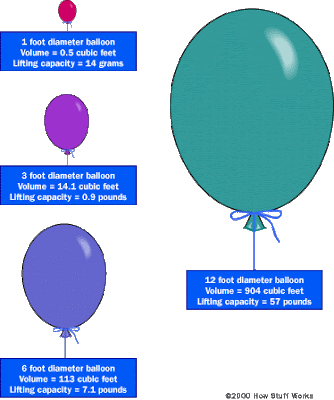
Balloons   If a cork is held below the surface of water and then released it rises. The density of cork is less than that of water, so the weight of water displaced is greater than that of the cork itself. In accordance with Archimedes' principle , the cork is acted upon by a resultant upward force equal to the difference between its own weight and the weight of the water it displaces .     A hydrogen-filled balloon rises in air for precisely thee same reason that the cork rises in water. The density of air is about 14 times that of hydrogen. The total weight of a balloon consisting of fabric and hydrogen is thus much less than the weight of air it displaces.   The difference between the two represents the useful lifting power of the balloon.   Ships, Cartesian diver and submarines   Bodies which are less dense than water float; those more dense sink. A piece of solid steel sinks, but a ship made of steel floats . Because a ship is h...

Archimedes' principle: Definition and experiment

Image
   Hi, I hope you are fine:)         T oday is a new day. This is a great branch of classical mechanics, fluid mechanics .     We'll begin our course with The principle of Archimedes.       W hen it was first proposed to build ships made of iron many people laughed at the suggestion. Owing to the fact that a piece of iron sinks when placed in water they held the view that iron ships would be a failure.       W hen anything is placed in a liquid it receives an upward force or upthrust. Today we shall describe a number of experiments to investigate the forces exerted on a body which is immersed or is floating in a liquid.   Apparent loss in weight      A simple but striking experiment to illustrate the upthrust ( buoyant) exerted by a liquid can be shown by tying a length of cotton to a brick. Any attempt to lift the brick...

To study the simple pendulum..Measurement of g

Image
  Hello everyone : )          Today we are  going to talk about : 1- Galileo Galilei               The equations of motion explained earlier were first worked out by Galileo Galilei, who was born at Pisa in Italy in 1564. Galileo began his university career as a medical student, but later forsook medicine for the study of mathematics and physics. His outstanding ability earned him a lectureship by the time he was twenty five years of age, and eventually he became professor at the University of Padua.   Later in life he was imprisoned for teaching that the sun was at the center of the solar system . This, being contrary to the teaching of the Church at that time, was regarded as an attempt to undermine its authority.           In the study of mechanics, Galileo is particularly remembered for the work he did o...

Equations of uniformly accelerated motion, with worked examples

Image
     If this is your first time please review Speed, velocity and acceleration from scratch   First equation of motion     Suppose a body which is already moving with a velocity of u in   m /s begins to accelerate at the rate of a in m / s ². The velocity will now increase by the numerical value of a in m/s for each second that it moves. The increase in velocity in a time t in s will therefore be equal to at .     Hence the final velocity at the end of t is given by                          v  = u + at .............................................. ( 1 ) This is called the first equation of motion.   Second equation of motion     If a body is moving with uniform acceleration its average velocity is equal to half the sum of the initial velocity u , and the final veloc...

Speed, velocity and acceleration from scratch

Image
  Average speed       Unless he or she is traveling on a superhighway, a motorist cannot usually maintain a constant speed for any length of time. In the ordinary way, traffic conditions frequently cause him or her to change speed or stop.          When deciding the time to allow for a particular journey, the motorist must therefore have some idea of the average speed at which he or she swill be able to travel.          Speed is defined as the rate of change of distance moved with time.     Thus, if a journey distance is 160 km, takes four hours,           average speed = distance / time = 160 / 4 = 40 km / h           During such a journey, however, the actual speed of the car at any instant will vary considerably from this figure. Actual speed   Normally, a d...