Memory Devices:Introduction, Memory Organization ,Memory Hierarchy, System Level Memory Organization ,Memory Device Organization, Memory Device Types ,Read-Only Memory , Random Access Memory (RAM) ,Special Memory Structures, Interfacing Memory Devices ,Accessing DRAMs , Refreshing the DRAM and Error Detection and Correction
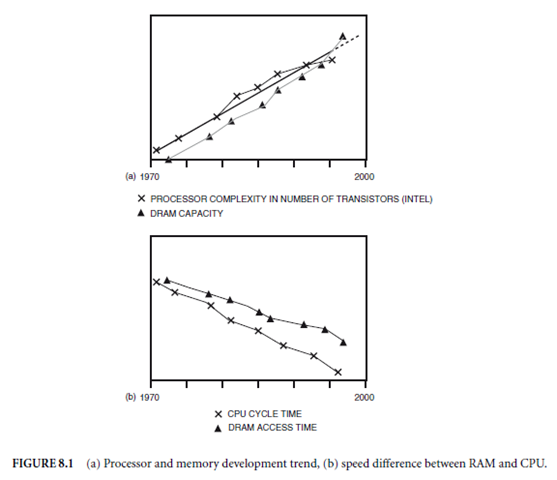
Memory Devices Introduction Memory is an essential part of any computation system. It is used to store both the computation instructions and the data. Logically, memory can be viewed as a collection of sequential locations, each with a unique address as its label and capable of storing information. Accessing memory is accomplished by supplying the address of the desired data to the device. Memory devices can be categorized according to their functionality and fall into two major categories, read-only-memory (ROM) , and write-and-read memory or random-access memory (RAM). There is also another subcategory of ROM: mostly read but sometimes write memory or flash ROM memory. Within the RAM category there are two types of memory devices differentiated by storage characteristics, static RAM (SRAM) and dynamic RAM (DRAM) respectively. DRAM devices need to be refreshed periodically to prevent the corruption of their contents due to charge leakage. SRAM devices, on the other hand, d...