Posts

Showing posts with the label Einstein’s Achievements

speaker:What It Does,How It Works,Construction,Multiple Drivers,Venting,Resonance,Miniature Speakers,Variants,Electrostatic Speaker,Powered Speakers and Wireless Speakers.

Image
speaker The term speaker is a diminution of loudspeaker . The full word is now so rarely used, some catalogs do not recognize it as a search term. This encyclopedia acknowledges contemporary usage by using speaker rather than loudspeaker . A fully assembled consumer product can be referred to as a “speaker,” but it also contains one or more individual components that are described as “speakers.” To resolve this ambiguity, referring to the components as drivers is helpful, but this practice can create more ambiguity because other types of components are also called “drivers.” The only real guide to the meaning of speaker is the context in which it is used. For the purposes of this entry, a speaker is a sound reproduction device , distinguished from a typical electromagnetic transducer by being larger and more powerful, with a more linear frequency response. A transducer may be used as a noise-creating device to provide an alert, informing the user of the status of a piece of equip...

Dispersion and color: Newton’s experiments

Image
   It had been known for centuries that small fragments of colorless glass and precious stones glittered in bright colors when white light passed through them, but it was NOT until the middle of the seventeenth century that Sir Isaac Newton investigated the problem systematically. Newton's work on this subject arose out of the need for finding a way of removing coloration from the images seen through a telescope. At that time this instrument had recently been invented by a Dutch spectacle-maker named Hans Lippershey . Newton's experiment with a prism Newton began his experiments by making a small hole in one of the window shutters of his room at Cambridge. Light from the sun streamed through this hole and made a circular white patch on the opposite wall. On placing a triangular glass prism before the hole, an elongated colored patch of light was formed on the wall. Newton called this a spectrum , and noted that the colors formed were in the order Red, Orange, Yello...

Electromagnetic waves illustration: Origin and sources

Image
Electromagnetic waves   When the wave theory of light first gained general acceptance it was considered that light waves were conveyed through a transparent elastic medium which filled the whole of space, even a vacuum. This substance was called the ether . Michael Faraday's move   A further step forward was made in 1845, when Michael Faraday showed that, under certain conditions, light was passing through a material medium were affected by a magnetic field. Now by that time, it was known that there was an inseparable connection between magnetism and electricity. Faraday's experiment gave a strong hint that light might well have electrical properties . It is James Clerk Maxwell's move   Some years later, the eminent mathematician and physicist, James Clerk Maxwell , became very interested in Faraday's work on electricity and eventually put forward a mathematical theory suggesting that an oscillating electric current should be capable of radiating ener...

How the wave Nature of light was first discovered

Image
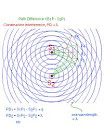
Strong evidence for the wave theory of light    First, we need to know:   Interference   When two ball-ended dippers are attatched to the vibrator of the ripple tank, two sets of circular ripples are sent out which pass through one another as shown in the image.   Where the two waves are superposed in the same phase, e.g., crest on crest, we get lines of increased disturbance or constructive interference . These are called the anti-nodal lines. In between these are the nodal lines along which the waves are exactly out of phase, e.g., the crests of one are superposed on the troughs of the other. Here, provided the amplitudes of the two waves are the same, we now get zero resultant disturbance of the water surface, or destructive interference .   A similar interference pattern is obtained if either a straight or a circular wave is incident on a vertical barrier having two small apertures. In this case, interference takes place between ...

Einstein’s unified field theory , and some of his early works

Image
Einstein’s unified field theory:     A simple general law combining the four forces of nature (the electromagnetic force, gravitation , the strong force , and the weak force) :           1. An electromagnetic force is exerted between electrical charges and magnetic fields. 2. Gravitational force is related to mass and acceleration and can affect electromagnetic radiation. 3. The gluon of the strong force holds the nuclei of atoms together. The positive protons and quarks in an atom’s nucleus would repel each other and fly apart if it was not for the ‘‘glueballs’’ of the strong force that ‘‘bind’’ the quarks and protons.            4. The weak force is responsible for the slow nuclear processes that produce radiation, such as beta decay of the neutron to generate high-speed electrons. Albert Einstein spent the last thirty years of his life seeking to combine these ...

Quantum Physics Parallel Universe

The food we eat, different people, stars, grains of sand; all come together to form the world we know. In this world, we are all truly unique and action we take has unique implications. However, if we go by the parallel universe theory we exist in more than one universe taking different actions with different implications. In fact, this theory states that every possible action and outcome has a parallel universe dedicated it. It may be difficult to digest the fact that alternate versions of us exist in alternate universes but this theory, unlike others including time travel and past life regression, take roots from quantum physics experiments. To understand the parallel universe theory we need to look at everything that surrounds us including ourselves beyond the microscopic level. We are all made of up of tiny atoms that that co-exist and function in an organized yet chaotic manner. If we dig even deeper, we will realize that the root of all existence is vibrating energy in its purest...

The unit of work and energy was named after him: James Prescott Joule

Image
About James Joule James Prescott Joule   James Prescott Joule (1818–1889), Scotland.   James Prescott Joule was one of five children in the family of a well-to-do brewery owner. Since he was a sickly child with a spinal deformity, both he and his brother were educated at home until the age of 15 and later by private tutors.    The famous English chemist, John Dalton , taught them chemistry, physics, and the methods of scientific experimentation .    Later in life Joule acknowledged that John Dalton encouraged him to increase his knowledge of science and of original research.   When James’ father died, he and his brother ran the brewery, which prevented him from attending a university. However, this did not deter him from setting up a laboratory in his home and continuing his interest in science after his day at the brewery. He became proficient in mathematics and learned how to make accurate measurements in the ...

Newton's law of universal gravitation vs Einstein’s principle of gravity

Image
Gravitational force    The force of which we are constantly aware in our daily lives is that which pulls us towards the earth. This is called gravitational force . Sir Isaac Newton came to the conclusion that gravitational force exists between all bodies. Thus, two stones are not only attracted towards the earth but also attract each other. Normally, we do not notice this force owing to its smallness, although it can be measured with sensetive instruments. Nevertheless, two 50000 t ships lying side by side attract each other with a force of about 18 N.        Newton's law of universal gravitation states that any two particles of matter attract one another with a force which is proportional to the product of their masses and inversely proportional to the sqaure of their distance apart.       F = G m1 m2/r². where       G is the gravitational constant, approximately equal to 6.674×10-...