Posts

Showing posts with the label science videos

Turning Forces. Principle of Moments
Image
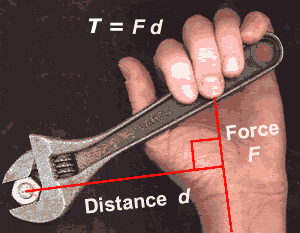
This is a quote I like very much:   “Great minds have purposes, others have wishes.” Washington Irving Now let’s have a purpose, learning :) Every time we open a door, turn on a tap or tighten up a nut with a spanner, we exert a turning force . Two factors are involved here, 1- The magnitude of of the force applied 2- The distance of its line of action from the axis or fulcrum about which turning takes place . A very large turning effect can be produced with a comparatively small force provided the distance from the fulcrum is large. For this reason, it is easier to loosen a tight nut with a long spanner than with a short one.   Experienced mechanics are aware that long spanners must be used with care, as it is easy to strip screw threads by too large a turning force. I think you –my dear reader- are ready for the following definition. The moment of the force The combined effect of the force and distance which determines the magnitude of the t...

Graham's law of diffusion - Further illustration of surface tension

Image
Graham's law of diffusion The speed with which molecules move about inside a gas depends on their mass and temperature . Thus, at a given temperature the heavy molecules of carbon dioxide " CO2" move more slowly than the light molecules of hydrogen . This has an important bearing on the rate at which one gas will diffuse into, or mix with, another.     Tomas Graham found that, at constant temperature gases diffuse at rates which are inversely proportional to the square roots of their densities. This is known as Graham's law of diffusion. This video demonstrates this law Diffusion experiment      The difference in the rates of diffusion of two gases through a porous partition may be demonstrated by a simple experiment.- I'm sorry but you have to use your imagination :) -.  An unglazed earthenware pot is fitted with a rubber bung and a length of glass tubing and set up vertically with the tube dipping into a beaker of water . When the porous...

Archimedes' principle: worked examples

Image
Archimedes' principle: worked examples 1. A ship of mass 1200 t floats in sea-water. What volume of sea-water does it displace?If the ship enters fresh water, what weight of cargo must be unloaded so that the same volume of water is displaced as before? ( Density of fresh water = 1000 kg/m³ , relative density of sea-water = 1.03; 1t = 1000kg)     Solution   Mass of sea water displaced    = 1200 t     Density of sea-water            =1000×1.03 kg/m³         Volume displaced = mass/density = 1200×1000/1000×1.03 m³ = 1165 m³ of sea-water The same volume of fresh water weights 1165×1000 kg = 1165 t Therefore, weight of cargo to be unloaded = 1200 - 1165 = 35 t 2. What volume of brass of density 8.5 g/cm³ must be attached to a piece of wood of mass 100 g and density 0.2 g/cm³ so that the two together will just submerge beneath water? Solution   The brass and wood together will just...

Balloons and floating bodies

Image
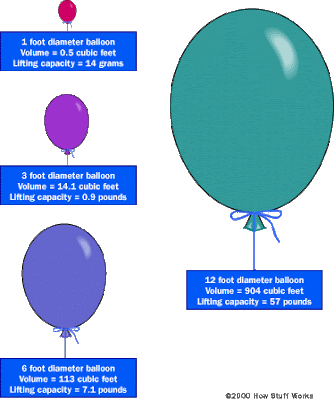
Balloons   If a cork is held below the surface of water and then released it rises. The density of cork is less than that of water, so the weight of water displaced is greater than that of the cork itself. In accordance with Archimedes' principle , the cork is acted upon by a resultant upward force equal to the difference between its own weight and the weight of the water it displaces .     A hydrogen-filled balloon rises in air for precisely thee same reason that the cork rises in water. The density of air is about 14 times that of hydrogen. The total weight of a balloon consisting of fabric and hydrogen is thus much less than the weight of air it displaces.   The difference between the two represents the useful lifting power of the balloon.   Ships, Cartesian diver and submarines   Bodies which are less dense than water float; those more dense sink. A piece of solid steel sinks, but a ship made of steel floats . Because a ship is h...

Newton's law of universal gravitation vs Einstein’s principle of gravity

Image
Gravitational force    The force of which we are constantly aware in our daily lives is that which pulls us towards the earth. This is called gravitational force . Sir Isaac Newton came to the conclusion that gravitational force exists between all bodies. Thus, two stones are not only attracted towards the earth but also attract each other. Normally, we do not notice this force owing to its smallness, although it can be measured with sensetive instruments. Nevertheless, two 50000 t ships lying side by side attract each other with a force of about 18 N.        Newton's law of universal gravitation states that any two particles of matter attract one another with a force which is proportional to the product of their masses and inversely proportional to the sqaure of their distance apart.       F = G m1 m2/r². where       G is the gravitational constant, approximately equal to 6.674×10-...

science-videos make physics easy

Image
       This video demonstrates Newton's First law of motion : This video demonstrates Newton's Second law of motion : This video demonstrates Newton's Third law of motion : This video demonstrates : Special relativity   Magnetic Fields Illustration.wmv