Posts

Showing posts from November, 2012

The EMF and the Electromagnetic Torque of a D.C. Machine

Image
The EMF and the Electromagnetic Torque of a D.C. Machine For any d.c. machine the basic equations are those describing the emf induced in the armature winding and the electromagnetic torque produced by the interaction of the armature current with the main magnetic field of the machine. As a conductor of the armature win­ding moves in the magnetic field under a pole (Fig. 1.14), the conductor cuts we magnetic lines of force, and this in­duces in it an emf given by e 1 = IvB where I is the active length of the con­ductor and v is the peripheral speed of «ie armature. FIGURE 1.14 The above equation defines the in­stantaneous emf which varies with changes in the magnetic induc­tion along the pole pitch. To find the average emf, we substitute in the above equation the average magnetic induction B ay , that is °ne under a pole but averaged over the pole pitch E 1,av = IvB av The peripheral speed v may be expressed in terms of the rotation­al speed n of the armature (in rp...

Drum Armature Windings

Image
Drum Armature Windings , The conductors placed in the armature slots must be interconnect­ed in a proper way so as to make up the armature winding. Most of the present-day d.c. machines use a drum armature which is a cylinder (see Fig. 13.3) assembled from electrical-sheet steel laminations insulated from one another. The sides of each turn in a drum winding are spaced approximately a full pitch, t. apart, so that the emfs induced in both sides of a turn will combine. In this way, each turn encloses nearly all of the flux in one pole of a machine. Sometimes, short-pitch turns are used, that is, those in which the width of a turn is less than the pole pitch. This is done in order to reduce the size of the coil ends. Instead of one turn the slots usually receive multiturn coils (Fig. 1.12 b). The coils may be connected to form a complete ar­mature winding in any one of two basic ways. With one the resui is what is called a lap winding: for connection to the next coil, the firs...

Operation of Brushgear and the Commutator

Image
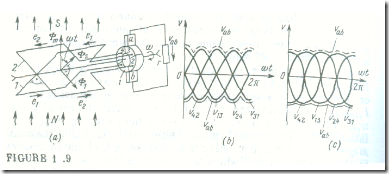
Operation of Brushgear and the Commutator An alternating emf is induced in the rotating armature winding of a d.c. machine, and it needs rectification, which is done by the commutator. The rectification of the emf induced in a d.c. machine can conveniently be traced using as an example a d.c. generator (Fig. 1.9 a) in which the armature core is absent , the magnetic field set up by the main poles is uniform, and the armature winding is made up of two separate turns, 1 and 2, arranged to be at right angles to each other and connected to the commutator . When the turns 1 and 2 rotate clockwise at an angular velocity ω , an emf i s induced in them, its positive direction being given by the corkscrew rule (see Fig. 2.5 b), and its magnitude being given by Eq. (2.15) e 1 = — dΦ 1 /dt = E m cos ωt e 2 = — dΦ 2 /dt = E m sin ωt where Φ 1 = — Φ m sin ωt and Φ 2 = Φ m cos ωt are the components of the main flux Φ m , normal to the planes of the turns 1 and 2. Since ...

Construction of D.C. Machines

Image
1.1 General Direct-current electric machines (generators and motors)  have a wide field of application. The primary advantage of d.c. motors is that their speed can be readily varied as desired and that they can deve¬lop large starting torques. For this reason d.c. motors are widely used for electric traction tramways, trolleybuses and railways), and as drives in a variety of manufacturing and process plant. Low power d.c. machines are employed to actuate final control elements and to serve as speed sensors in automatic control systems. Direct-current generators are used to supply power for radio equipment, for battery charging, for electrolytic cells, and the like. A disadvantage common to all d.c. machines is the complexity of design. mainly due to the use of brush gear . Apart from its com¬plex design, brush gear is subject to sparking. This reduces their reliability and limits their applicability. A substantional limitation is that a.c. supply for d.c. motors has to b...