Posts

Showing posts from January, 2013

The Equivalent Circuit for a Phase of an Induction Motor

Image
The Equivalent Circuit for a Phase of an Induction Motor In calculating the process taking place in an induction motor, resort is usually made to the equivalent circuit of one phase. This circuit is assumed to include fixed resistive and inductive elements and also a variable resistive element to represent the mechanical load applied to the motor shaft. The difficulties. in developing such an equivalent circuit arise because, firstly, the frequency of the stator phase currents is f and that of the rotor phase currents is f 2 = f s , secondly, the stator phase has w 1 turns and the rotor phase has w 2 turns, thirdly, the two windings differ in the winding factors k w 1 and k w 2 and fourthly, the stator has m l = 3 phases and a squirrel-cage rotor has m 2 = N pha­ses. Therefore, all rotor phase quantities must be referred (or trans­ferred) to the respective stator quantities. To begin with, we will refer the rotor phase quantities to the sta­tor phase frequency. To this...

The Equation of Electric State for a Rotor Phase of an Induction Motor

Image
The Equation of Electric State for a Rotor Phase of an Induction Motor The revolving magnetic field induces in a rotor phase an emf, e 2 , at frequency f 2 = P ( n l - n )/60. We can express this frequency in terms of the supply-line frequency on dividing and multiplying the right-hand side of this expression by n 1 . Then. in view of Eqs. (14.7) and (14.8). we get f 2 = fs                                     (14.12) which tells us that the slip frequency, f 2 is equal to the product of the supply-line frequency by the slip. The emf in a stator phase winding, e 1 . and the emf in a rotor phase winding. e 2 are induced by a revolving magnetic field which is common to the two windings and is produced by the joint action of the stator current it and the rotor current i 2 . However, e 1 opposes a change ...

The Equation of State for a Stator Phase of an Induction Motor

Image
The Equation of State for a Stator Phase of an Induction Motor The emf induced in each turn of the stator winding by the revol­ving magnetic field, is, in accord with Eq. (2.2), given by e turn = - dΨ/dt Since it is legitimate to assume that the normal component of the magnetic induction is distributed sinusoidally around the cir­cumference of the rotor, the flux linkage of the turn as the field re­volves will also vary sinusoidally with time Ψ = Φ turn sin É· t .Therefore the rms value of the emf induced in a stator turn can be found from the equation for transformer emf, Eq. (7.2c) E turn = 4.44/ Φ turn In contrast to a transformer, however, Φ turn symbolizes the avera­ge (constant) rather than peak value of the revolving magnetic flux threading the turn Φ turn = Æ– ∫ 0 Ï„ B m sin (Ï€/Ï„) z d z = (2Ï€ Æ– /Ï€) B m where Æ– is the rotor length and Ï„ is the pole pitch. 'When defining the emf, e 1 , induced in each of the stator phase win­dings, it should be ...

The Revolving Rotor Field and the Working Revolving Field in an Induction Motor

The Revolving Rotor Field and the Working Revolving Field in an Induction Motor To begin with, let us assume that the rotor circuit is open so that there is no current flowing in it, no electromagnetic forces are acting on the rotor, and it is at rest. Then the magnetic field in the machine will be solely due to the revolving magnetic field of the stator. The winding of a squirrel-cage rotor consists of N bars. The phase difference between the emfs induced in two adjacent bars by the re­volving magnetic field of the stator is 360 0 p / N , It may be taken that the number of phases in a squirrel-cage rotor is equal to the number of bars. m 2 = N , and that each phase has w 2 = 1/2 turn. Similarly, the circuit of a wound rotor is a three-phase system, m 2 = 3, with w 2 turns per phase. (Here and elsewhere the quantities related to a rotor phase will be labelled "2", and those related to a stator phase will be labelled "1".) So long as the rotor is at rest...

The Modes of Operation of a Three-Phase Induction Machine

Image
The Modes of Operation of a Three-Phase Induction Machine The mode of operation for a three-phase induction machine de­pends on the interaction between the currents in the stator and rotor windings. The interaction of the revolving magnetic field produced by the currents in the stator winding with the currents in the rotor winding causes the rotor to rotate with the revolving field. However, as the speed of the rotor increases, the emfs induced in its winding and, in consequence, the associated currents decrease. If the speed of the field is n l and the speed of the rotor is n , the mode in which an induction machi­ne operates can he defined in terms of the slip which is given the symbol s and is defined as follows: s = ( n 1 – n )/60                                    (14.8) A plot of the rotor speed ...

The Revolving Magnetic Field of the Stator

Image
The Revolving Magnetic Field of the Stator When three-phase voltages are applied to the stator-winding ter­minals, balanced three-phase currents flow in the phase windings and a rotating magnetic field is produced in the air gap of the machi­ne. This field induces an emf in the rotor winding shorted together or connected in series with a starting rheostat. The currents thus in­duced produce a revolving magnetic field of their own. The speed and direction of rotation of the two fields are the same, so they combine to yield the operating revolving field of the machine. Consider the revolving stator field, assuming that the rotor cir­cuit is open. Above all this field depends on the geometric arrange­ment of the-phase windings on the stator. A two-pole revolving field . A two-pole revolving field will be produced when the three identical phase windings are positioned on the stator so that they are spaced 120 0 apart. In Fig. 7 c , each phase winding is represented by a single turn ...

Induction Machines

Image
Induction Machines Of the many types and forms of present-day electric machines those most commonly used are induction machines. ordinarily employed a motors. An induction machine is all a.c. two-winding unit in which only one (usually the stator) winding is supplied with an alternating cur­rent at a constant frequency from an external source, while in the other (usually the rotor) winding currents arise from induction. The fact that the rotor currents are produced by induction is the basis for the name of this class of machines . Induction machines are also called "asynchronous" because their operating speed is slightly different from the angular velocity of the revolving magnetic field set up by the stator winding . An important advantage of induction machines is mat they have no readily damaged or wearing parts (such as a commutator) . Large induction machines are made three-phase .small induc­tion machines may be single- and two-phase . so they can operate off a...

Instrument Transformers

Image
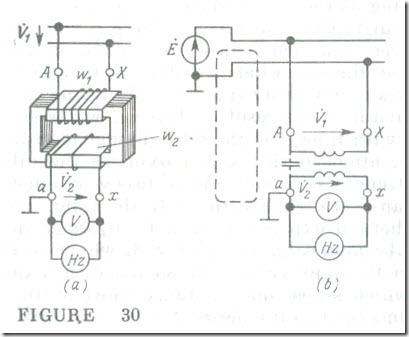
Instrument Transformers These may be current transformers and voltage transformers. They are used, firstly, for the purpose of changing currents or volt­ages in a power circuit to values which render them convenient for measurement, and secondly in order to extend the range of the asso­ciated instruments. Voltage instrument transformers are used in conjunction with volt­meters, frequency meters, the potential (shunt) circuits of wattmet­ers , electricity meters and phase meters, and relays. Current instrument trans­formers are used in conjun­ction with ammeters and the current (series) circuits of some instruments, and relays. A schematic diagram of a voltage (or potential) transformer is shown in Fig. 30 a, and its symbo­lic representation in Fig 30 b. This type of trans­former is similar to a small-power transformer. Its primary, or H. V., winding with w 1 turns is connected in the cir­cuit whose voltage V 1 is to be measured, and its secondary, or L.V., winding at a volt...

Heat Generation in and Cooling of Transformers

Heat Generation in and Cooling of Transformers The losses in a transformer are small in relative terms, but they are appreciable in absolute terms, especially in large-size units. Therefore, a major task in transformer design is to provide for prop­er withdrawal of the heat generated in the core and coils to the sur­roundings. The task grows progressively more complicated as the transformer size increases. Given the magnetic induction in the core and the current density in the coils, the losses in a transformer rise in proportion to its volume (that is, the third power of its linear di­mensions), whereas the cooling area increases only in direct propor­tion to the square of the increase in linear dimensions. In consequence, the increase in transformer rating entails a rapid increase in the required rate of heat transfer from its surface. This can be done by increasing the cooling surface area of a transformer, or by raising the rate of heat transfer by some artificial means. On t...