Posts

Showing posts from February, 2013

Binary Representation of Characters
Image
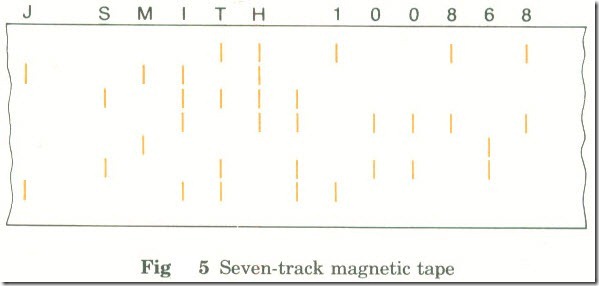
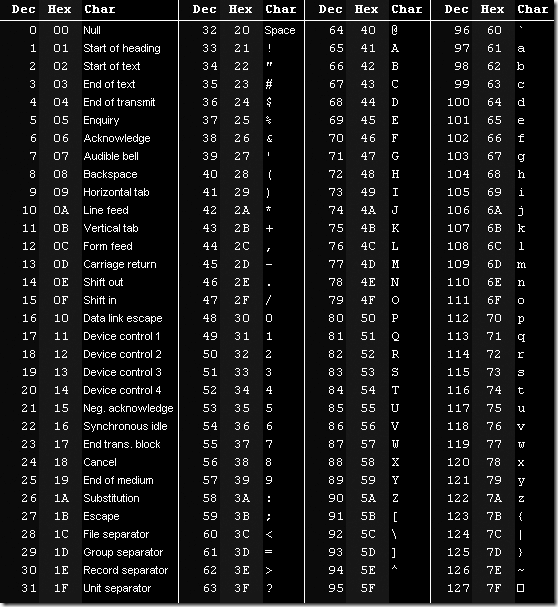
Binary Representation of Characters When characters are transmitted or stored each character is represented as a binary string. The number of bits used to represent each character differs from one system to another. On punched cards there were 12 hole positions for each character, and on some paper tapes there were only 5. In most modern systems, seven, eight or nine bits are used. In general the number of different characters which can be encoded is 2 n , where n is the number of bits used for each character. e.g. The number of different characters you can have with an eight-bit code is 2 8 = 256. Worked question Eight-bit storage locations are used to store coded characters. One bit is a parity bit. 0000 0000 and 1111 1111 both have special uses and cannot be used to code characters. How many different characters can be represented? Seven bits are used for the actual code. Seven bits gives 2 7 = 128 characters. Two codes cannot be used No. of possible characters =...
Octal and Hexadecimal

Image
Octal and Hexadecimal Octal numbers are numbers written in base 8. Hexadecimal numbers are numbers written in base 16. Decimal Binary Octal Hexadecimal (base 10) (base 2) (base 8) (base 16) 0 0000 0 0 1 0001 1 1 2 0010 2 2 3 0011 3 ...

Accuracy

Image
Accuracy Numbers are not necessarily stored in a computer with perfect precision. Each number is allowed only a certain number of bits for storage. Usually integers are stored accurately with a limited range. Real numbers are stored with a large range but less accuracy (using floating-point representation). RANGE OF BINARY INTEGERS Positive integers As the numbers are all positive no sign bit is necessary. The largest number which can be stored in a register with n bits is 2 n – 1. The smallest number which can be stored is 0 . Example For an eight-bit word the largest number possible = 11111111 2 =100000000 2 -1=2 8 -1 (=255) Twos complement integers If twos complement integers are represented in a register or location of n bits, then the largest positive number possible = 2 n -1 -1 the most negative number possible = -2 n -1 -1 Example For an eight-bit word the largest number possible =01111111 (as the first bit is a sign bit) =2 7 -1 (=127) T...

Representation of Fractions in Binary

Image
Representation of Fractions in Binary   FIXED·POINT REPRESENTATION Fractions can be written in binary by extending the binary notation explained for integers above. In a binary number the digits after the point represent 1/2, 1/4, 18/, etc. Worked question Give the decimal equivalents of the binary numbers (a) 110.11 (b) 0.001 (a) 110 2 =6 10   0.11 2 =1/2+1/4=0.5+0.25 =0.75 ∴ 110.11 2 =6.75 10 (b) 0.001 2 = 1/ 8 =0.125 10 A fixed-point number is one which is represented by a set of digits with the point in its correct position. e.g. 313.45 is a fixed-point decimal number; 1101.1101 is a fixed-point binary number. FLOATING-POINT REPRESENTATION The mantissa of a number consists of the actual digits in it. The point is put at some fixed position (often in front of the first digit). e.g. The mantissa of 34.234 is .34234 The exponent of a number gives the position of the binary or decimal point. e.g. If the position is measured from...

Positive and Negative Integers

Image
Positive and Negative Integers The ones complement of a binary string is formed by replacing 0s by 1s and 1s by 0s. The twos complement of a binary integer is formed by finding the 1s complement of the number and adding 1 to it. Worked questions 1- Find the ones complement and twos complement of 000101101 To find the ones complement replace 0 by 1, 1 by 0 Ones complement of 000101101 = 111010010 Twos complement of 000101101 = Ones complement + 1                                                              = 111010010+                           ...

Binary Conversion

Image
Binary Conversion Power, p 2 P 0 1 1 2 2 4 3 8 4 16 5 32 6 64 7 128 8 256 9 512 Fig 2 Some powers of 2 CONVERSION OF DECIMAL INTEGERS TO BINARY Method 1- Write out powe...

Binary Representation of Numbers

Image
Binary Representation of Numbers An integer is a whole number. It may be positive or negative. Ordinary numbers are called real numbers. This includes all integers and all numbers with a decimal point. There are various ways in which integers can be represented using 1s and 0s. The binary notation is a method of representing numbers using 1s and 0s (Fig 1), In a binary number each 1 represents a power of 2. The powers of two are the numbers 1, 2, 4, 8, 16, etc. (see Fig 2). Decimal number Binary equivalent 0 0 1 1 2 10 3 11 4 100 ...

REPRESENTATION OF DATA

Image
REPRESENTATION OF DATA All storage in modern digital computers is two state. This means that the smallest unit of the store is a device which can be set to one of two states and will stay in this state for as long as required. Examples of two-state devices used as stores 1- A circuit known as a bistable which can be put either into a state where it outputs 5 volts or into another stale where it outputs 0 volts. 2- A 'magnetic bubble', a small area of material which can be magnetized either in the opposite direction to the surrounding material or in the same direction. Usually the two states are represented by 1 and 0. A single 1 or 0 is a binary digit or bit. Each location of the immediate access store contains a number of bits. A word is the group of bits treated by a given computer as its working unit. Each location will contain one word. A byte is a small group of bits treated as a unit. It is usually the number of bits needed to store one character. In many ...

Processing

Image
Processing At the heart of the data processing cycle will be a process in which data has various operations carried out on it: 1- Calculation-numbers may have arithmetic performed on them. 2- Analysis- numbers or text may be analysed . 3- Comparison-data items may be compared with one another or with a set value. The process may then take a different course depending on the result of the comparison. 4- Manipulation-data may be rearranged into a new order (i.e. sorted), merged with other data, etc. Examples Without a computer Calculation-a shop assistant uses a till to add up purchases. Analysis-a shop manager analyses the takings to see which goods sell well Comparison-a car driver sees a speed limit sign, checks the speedometer and slows down if necessary. Sort-a teacher collects examination papers and puts them into alphabetical order. With a computer Calculation- in running a payroll program the number of hours an employee works, his rate of pay and tax ...

Data Collection and Input

Image
Data Collection and Input DATA COLLECTION Data collection means bringing together all the data for an application and getting it ready for processing. Examples of data collection 1 Bank cheques are sent from branches to a central clearing house. There they are put together for sorting and updating accounts. 2 Application forma for subscriptions to a magazine are sent out to possible customers. Those who want the magazine fill in the for-ms and send them back. Their details are then typed into a computer via a keyboard. DATA CAPTURE Data capture means obtaining data for a computer. Usually the term is used in situations where a computer peripheral inputs the data automatically. Examples of data capture 1- At a particular supermarket checkout there are POS terminals. Each product has a catalogue number that is encoded on a bar code. This can be read using a light pen . 2- An examination candidate does a multiple choice test by marking a card with a pencil in the ri...

Encoding and Decoding

Image
Encoding and Decoding To encode means to convert information or data into a form ready for processing. To decode means to convert data back to a form where it can be understood. Examples of encoding where data is encoded as it is input 1- An interactive program is run on a microcomputer and data is typed in at the keyboard. Circuitry in the keyboard encodes the characters as they are typed in. 2- A microprocessor controls a chemical process. Measurements are taken by instruments connected to the processor. An interface converts the data to binary data which the microprocessor can deal with . Examples where data is encoded first and then input later 1- Information about foods is encoded into bar codes which are then printed on food labels. This data can then be input via a laser scanner on a point-of-sale (POS) terminal at the checkout . 2- A school sends details of all its new pupils to a computer bureau. There they are keyed on to a floppy disc (for key-to-disc). The...

The Data Processing Cycle

Image
The Data Processing Cycle When data is collected and processed, whether by a computer or by other means, a set of operations is carried out on it. This set of operations is called a data processing sequence or a data processing cycle. Fig 2 The data processing cycle Figure 2 is a very general diagram of a processing cycle. Data which is output may be used as input, perhaps at a later date, thus completing the cycle. (In the diagram OUTPUT is linked to DATA COLLECTION by a broken line to indicate that this only happens sometimes.) Some operations may occur at different points in the cycle, between or as part of the operations shown in Fig 2 . STORAGE Data may be held for various lengths of time on a suitable material (or medium). Worked question Give three examples of data being stored, each one being at a different stage of the data processing cycle. 1- As the last stage of data collection data may be keyed on to disc, where it is stored while awaiting input to a comp...

INFORMATION PROCESSING

Image
INFORMATION PROCESSING   Information consists of facts and items of knowledge. It can be anything that has meaning to people. Usually information is expressed in words and numbers. However, it can be expressed in other forms, such as sounds, measurements or pictures. Examples of information 1- A list of names and addresses. 2- The contents of a letter. 3- What is said in a telephone conversation. 4- The words of a song. 5- A map. Information processing is the organization, manipulation and distribution of information. Examples of information processing 1 Sorting a list of names and addresses into alphabetical order. 2 Producing a letter with a word processor, saving it on floppy disc and then sending it by electronic mail. 3 Transmitting a conversation over the telephone system. People can process information without using machines. Examples are: 1 Listening to songs and deciding which ones are best. 2 Reading a map to get from one place to another. ...

THE GENERAL CERTIFICATE OF SECONDARY EDUCATION (GCSE)

Image
THE GENERAL CERTIFICATE OF SECONDARY EDUCATION (GCSE) Since 1988 all students in England, Wales and Northern Ireland have been able to take the General Certificate of Secondary Education examinations-the GCSE. At the moment a new Standard Grade examination is being introduced in Scotland, although centres will still be able to enter candidates for the Ordinary Grade examinations. This book takes into account both of these examinations and is suitable for candidates of both. Outside Scotland, for the GCSE, the Examination Boards have been grouped together so that there are six different syllabuses. There are four Groups or Associations in England, one in Wales and one in Northern Ireland. The syllabuses are all based on a set of guidelines called 'The National Criteria'. As a result they share some common themes, although there are also some important differences between them. For the GCSE in Computer Studies candidates are expected to be able to use computers to solve...

The GCSE Examination Boards: Addresses

Image
Examination Boards: Addresses Northern Examining Association JMB                 Joint Matriculation Board                          Devas Street, Manchester M15 6EU ALSEB             Associated Lancashire Schools Examining Board 12 Harter Street, Manchester M1 6HL NREB              Northern Regional Examinations Board                         Wheatfield Road, Westerhope , Newcastle upon Tyne NE5 5JZ NWREB          North-West Regional Examinations Board        ...