Posts

Showing posts from October, 2014

Power and Refrigeration Gas Cycles: The Brayton Cycle , The Regenerative Brayton Cycle and The Gas Refrigeration Cycle
Image
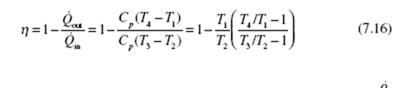
7.5 The Brayton Cycle The gas turbine is another mechanical system that produces power. It may operate on an open cycle when used as a truck engine, or on a closed cycle when used in a power plant. In open cycle operation, air enters the compressor, passes through a constant-pressure combustion chamber, then through a turbine, and finally exits as products of combustion to the atmosphere, as shown in Fig. 7.4 a . In closed cycle operation the combustion chamber is replaced with a heat exchanger in which energy enters the cycle from some exterior source; an additional heat exchanger transfers heat from the cycle so that the air is returned to its initial state, as shown in Fig. 7.4 b. The ideal cycle used to model the gas turbine is the Brayton cycle . It utilizes isentropic compression and expansion, as indicated in Fig. 7.5. The efficiency of such a cycle is given by   F i g u re 7.4 The Brayton cycle components. ( a ) Open cycle. ( b ) Closed cycle. F i g u re...

Power and Refrigeration Gas Cycles: The Air-Standard Cycle , The Carnot Cycle , The Otto Cycle AND The Diesel Cycle

Image
P o w er and Refrigeration Gas Cycles Several cycles utilize a gas as the working substance, the most common being the Otto cycle and the diesel cycle, used in internal combustion engines. The word “cycle” used in reference to an internal combustion engine is technically incorrect since the working fluid does not undergo a thermodynamic cycle; air enters the engine, mixes with a fuel, undergoes combustion, and exits the engine as exhaust gases. This is often referred to as an open cycle , but we should keep in mind that a thermodynamic cycle does not really occur; the engine itself operates in what we could call a mechanical cycle. We do, however, analyze an internal combustion engine as though the working fluid operated on a cycle; it is an approximation that allows us to predict influences of engine design on such quantities as efficiency and fuel consumption. It also allows us to compare the features of the various cycles. 7.1 The Air-Standard Cycle In this section we introduce...